
I’ve had to sit with this experience before I could write about it. Not because I couldn’t remember what happened… I remember it all. The people, the places, the meals, the conversations that linger long after they’ve ended. What I couldn’t do was make sense of it immediately. I needed to let it settle before I started putting words to it.
And like all epic tales, this one starts with an introduction.
Hi, my name is Tamara. I’m a forty-two-year-old woman, born and raised on St. Croix (Ay Ay), whose maternal family left Vieques when her mother was still an infant and whose father found his way to St. Croix from Trinidad at 17 for work and built a life in the U.S. Virgin Islands. I am a therapist, a mother, a wife, an art-maker, and a chronic overthinker. I am equal parts curious + cautious (maybe cautious > curious, but that’s for another conversation). I’m the kind of person who reads and re-reads my emails to make sure I didn’t leave something out (or my tone wasn’t too harsh). I scan and re-scan my boarding pass at least three times before I get on the plane to make sure I didn’t forget my seat number (don’t judge me!). I’m also very shy, an outgoing introvert. Even though I spend so much of my professional life talking to people, ask me to introduce myself to a group of strangers, and suddenly I’m wondering if I’ve said my name too loudly.
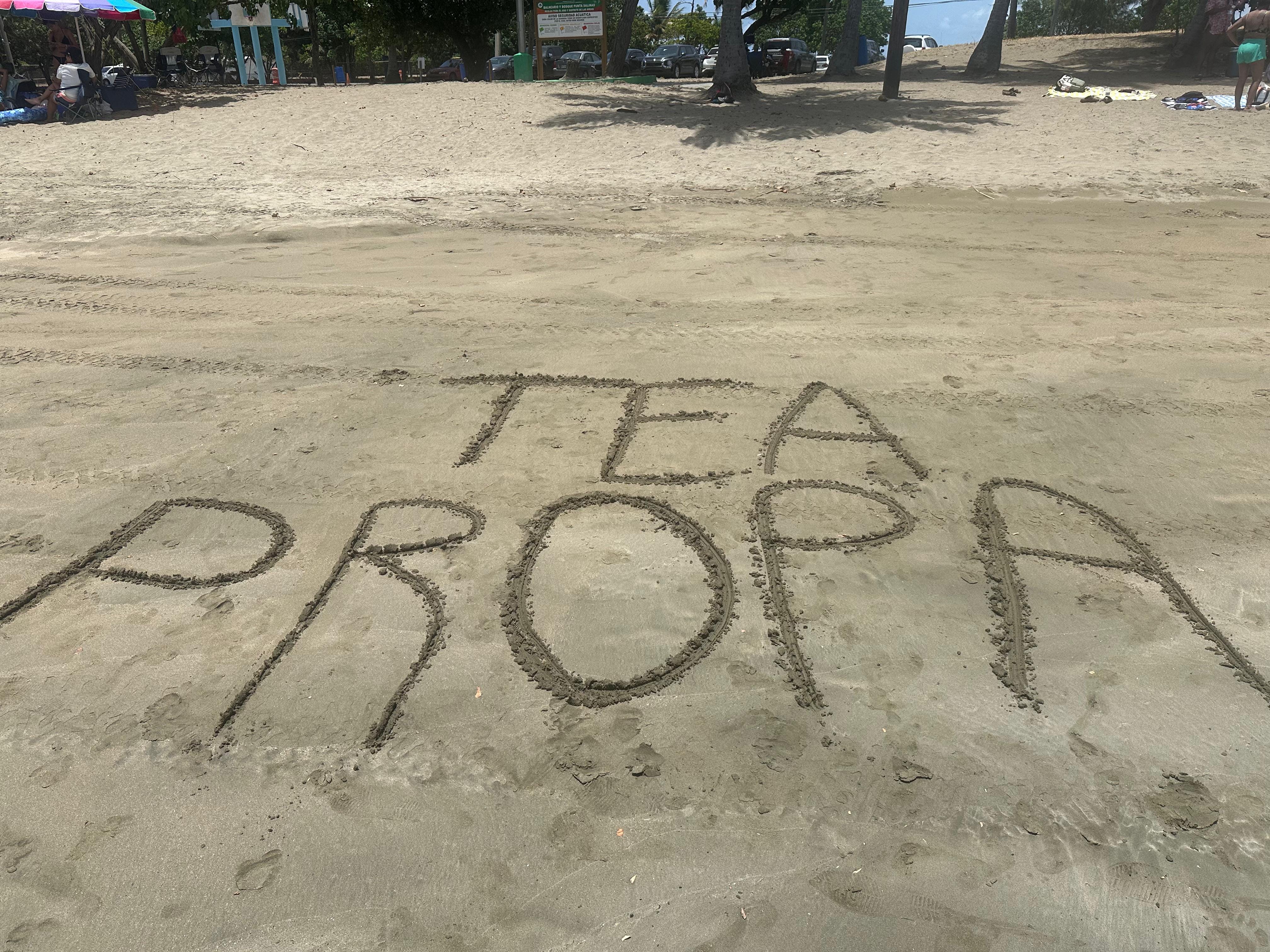
I also live in a pretty curated bubble. I don’t do much outside of my comfort zone, and I definitely don’t put myself out there a whole lot. So when I applied for the TEA x PROPA 2026 Field School, I honestly didn’t think I’d be selected.
The field school centered on Black Puerto Rican history through digital archiving, oral history, and community collaboration. The opportunity was to learn alongside scholars, artists, and community members while contributing to the preservation of histories that have too often been overlooked, misrepresented, or forgotten. It wasn’t just the subject matter that drew me in. It was the idea that preserving history could be something communities do for themselves, not something done for them.
I didn’t apply because I was looking for an adventure. I applied because something about the work felt familiar before I could even understand why
Growing up in the Virgin Islands, Puerto Rico was always present. Not as a place I knew well, but as a place woven into the fabric of everyday life. It was part of my family’s story. It showed up in Noche Buena gatherings that stretched well past midnight until all of the children had finally woken from their naps so Santa could leave presents and we could each open a single gift. It lived in my conversations with my grandmother, Mama, who spoke to me only in Spanish, whether I answered in English or not. It was in the music that turned every family gathering into a dance floor, and in the aunt (Titi so-and-so) who would inevitably pull us into the middle of the living room while we protested just enough to make everyone else laugh.
The older I’ve gotten, the more I’ve realized those memories weren’t uniquely mine. They were part of life in the Virgin Islands. Puerto Rican families have been part of the social and cultural fabric of these islands for generations. You hear it in the cadence of our conversations, taste it in our food, and feel it in the way our communities have always moved back and forth across the water. Growing up, I never separated those influences. They were simply part of what it meant to call the Virgin Islands home.
As I reflect, in the moment, they just felt like family traditions. But now I wonder if those are also archives. Not the kind stored in acid-free boxes or carefully catalogued on shelves, but the kind families carry in their recipes, language, music, and stories. In the rituals that survived migration, because someone decided they were worth holding onto. I don’t think I appreciated it until this summer.
I found out that I was accepted into the Field School in January - a whole six months before I would set foot onto that plane and into the experience. As the trip grew closer, excitement was overshadowed by anxiety. Besides a couple of Zoom calls, I had never met anyone else in the cohort. I wasn’t sure what to expect, and I worried I wouldn’t know enough. I worried that everyone else would already know each other, and I worried about all the things anxious people worry about when they’re stepping into something completely unfamiliar.
I went anyway.
I think this was the first lesson the field school taught me: belonging doesn’t always begin with confidence, but just showing up. I got there thinking I was going to learn a skill. I wanted to understand digital archiving. I wanted to learn more about Black Puerto Rican history, my history. I wanted to experience a place that existed outside the edges of my own story. Instead, I was tested.
Over the next two weeks, I would be asked to trust strangers (some of whom would become friends). I would have conversations that challenged the way I understood history, memory, and community. I would find myself standing in places that made my family’s stories feel less like distant history and more like something still alive. I would discover that preserving history isn’t only about documents and photographs. It’s also about relationships. About listening. About whose voices are remembered and whose are allowed to disappear.
I think I began to understand that the things I inherited as a child, my imperfect Spanish, my family’s traditions, the music, the food, the stories that traveled across the water from Vieques to St. Croix, weren’t just memories. They were evidence that my family had been carrying history all along, in their laughter, their food, their language, in the sway of their hips, and the way joy always seemed to find its way back into the room.
I thought I was going to Puerto Rico to learn about archives. Instead, I realize I’d been living in one my entire life. And that’s where this story really begins …
Learn More
This is the first in a series of essays reflecting on my experience with the TEAxPROPA Field School and what it taught me about memory, belonging, and home. I’m deeply grateful to the organizers, community partners, and fellow participants who made the experience what it was. Their work is important.
If you’d like to learn more about the organizations behind the field school and the work they’re doing to preserve and amplify Black Puerto Rican history through community-based archiving, oral history, the arts, and cultural preservation, I encourage you to explore the work of Taller Entre Aguas (TEA) and the Puerto Rican Organization for Performing Arts (PROPA).